Kathleen & May - 1900

The last remaining wooden hull three masted top sail schooner

The Kathleen and May was built in 1900 at Ferguson and Baird’s yard at Connah’s Quay near Chester, for Captain John Coppack of Coppack Bros. and Co., the town’s leading shipowners. The schooner was launched in April 1900 and named after the Captain’s two daughters, the Lizzie May. She was a three-masted topsail schooner of 136 tons gross (99 tons net), with a registered length of 98.4 feet, breadth of 23.2 feet and a hold 10.1 feet deep. She was planked with 3 inch thick seasoned pitch pine, laid on heavy doubled frames of oak and fastened with treenails and iron bolts. In her first 8 years she sailed nearly 40,000 miles, carrying various cargoes of over 24,000 tons from Oban to the Channel Islands, London and Ireland.

In 1908 she was purchased by Martin J Fleming of Youghal and renamed the Kathleen and May after his daughters. She became part of the owner’s fleet of coal ships, trading between the Bristol Channel ports and Youghal and was a familiar and much loved sight in Youghal Harbour for over 20 years.

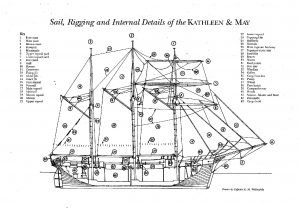
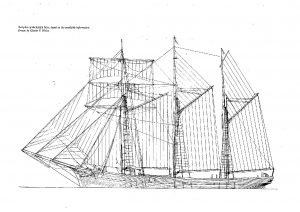
When the schooner was built, all three topsail yards were of almost the same size, but her new owner added a longer lower yard sometime before the First World War. At a later date a martingale was fitted to the bowsprit but this was removed in 1947. The original reefing gear fitted was the first known example of Appledore roller reefing, the sail being reefed by a ratchet lever that engaged the cogs on the gaff boom thereby winding the sail around it and then locked to prevent the sail unwinding from the boom. This has all now been fully restored.

The Kathleen and May was sold to Captain Jewell from Appledore in North Devon in 1931. The trip to her new home was to be her last journey under sail alone. On arrival she was given a refit, her topmasts were reduced in height and topsails removed. She was fitted with an 80bhp Beardmore engine.

She continued in the coal trade and was often seen plying her trade around the waters of Youghal. She survived the severe storms of February 1936 (when the Nellie Fleming was lost) and Martin J Fleming made sure that a watch was kept for her along the Waterford and Wexford coast. In 1937 she experienced engine trouble under Youghal’s lighthouse, but managed to steer clear of harm. In 1943 her old Beardmore engine was replaced by a second hand 125bhp Deutz. In 1945 William Jewell died and the schooner was left to his son Tommy and she continued trading until 1961. She is now equipped with a 400 hp Detroit (ex-lifeboat engine) with twin hydraulically driven props for manoeuvrability and carries enough fuel to do 2000 miles under engine alone.

During 1968, the Kathleen and May was discovered in bad repair by the Duke of Edinburgh who created the Maritime Trust in London to help preserve her. She was bought by them in 1970. They began restoring her as a typical West Country schooner, as she was the only remaining example of these trading schooners.

In 1998 Steve Clarke from Bideford in Devon bought her, after the Maritime Trust failed to secure a £2 million lottery bid. She was towed back to Bideford and moored at a disused coal wharf where restoration work began.

The schooner was craned out using massive 1000 ton cranes. The stern of the ship was stripped down to the keels and 70% of the 3 inch external planking removed. All though the bows appeared intact, they had to be removed as there were problems encountered behind them. This involved the replacement of six and a half tons of sacrificial timber. The exposed frames that did not need replacing were steamed down with 3000 psi of steam in order to kill the fungal spores. Most of her internal timbers remain original.

After the external work was completed, she was re-decked and given a second refit; all masts and rigging being restored to original 1900 specifications before she underwent a rigid MCA CAT2 inspection.

The Kathleen & May has now sailed across the Irish Sea and the Bristol Channel several times and has attended festivals in Dublin, Bristol, Derry and her old home port of Youghal. She has crossed the Bay of Biscay to Bilbao where she was the paid guest of the famous Guggenheim museum for three weeks.